Types Of BOSU Ballast Ball Exercises

Squat

Place the BB on the floor so that the circles are on top of the ball. Stand in front of the BB and squat down, sitting on the inner circle. Stand up and repeat for 10-16 reps. To make it harder, don't sit all the way down and hold weights for added intensity. Try to keep your movements controlled so that the BB doesn't move at all when you stand up.

bosu_vsit.jpg (14462 bytes)


Squat Crunch

This fun move targets the lower body and the abs. With the circles directly on top of the BB, squat down and sit on the outer edge of the larger concentric circle. Lean back all the way, do a crunch and then sit up and stand. Repeat for 10-16 reps. Add intensity by doing more crunches or adding a jump as you stand up.

bosu_vsit.jpg (14462 bytes)bosu_vsit.jpg (14462 bytes)


The Spider

This is a favorite of mine and quite challenging. Get on all fours to the left of the BB (the circles should be showing on each side and on top of the ball). Lean the right hip into the outer concentric circle of the ball and keep turning the body until you're on top of the ball. Add a crunch here if you like or keep rolling over until you're on the right side of the ball. Continue rolling over the top of the ball for 8-12 reps.


bosu_vsit.jpg (14462 bytes)bosu_vsit.jpg (14462 bytes)bosu_vsit.jpg (14462 bytes)

Lunge Stretch

The BB is also great for stretching because it doesn't roll away. For this one, stand behind the BB and lunge forward to the right of the ball. Lean the left hip into the ball and stretch the right arm up and over, feeling a stretch in the right waist. Go back to the start and repeat on the other side for 8-12 reps.

bosu_vsit.jpg (14462 bytes) bosu_vsit.jpg (14462 bytes)


Reverse Impact Shifts

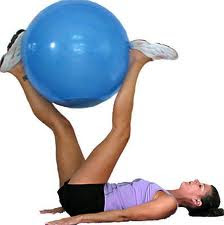
This is another tough ab move. Hold the ball between the lower legs off the floor and lean back on the forearms, keeping the back straight. Don't sink into the shoulders. Getting a good grip on the ball, explosively straighten the legs, taking the ball up and trying to move the weight to the other side of the ball (you may not get it all the way there). Lower and repeat for 8-12 reps.

bosu_vsit.jpg (14462 bytes) bosu_vsit.jpg (14462 bytes)


Ball Rotations

This is an advanced move and requires good hamstring flexibility. Lie down with the ball between the feet, gripping it hard. Rotate the ball and bring the right foot in front, left foot in back. Lower the legs towards the floor. Bring them back up and rotate the ball with the left foot in front, right foot in back. Lower again and then repeat for 6-10 reps.


bosu_vsit.jpg (14462 bytes) bosu_vsit.jpg (14462 bytes)

Ball Exchange
This is a common move you can do with a regular ball, but the added weight of the BB adds intensity. Start with the ball between the feet and lower the legs down while reaching the arms out and way. Bring the ball in and grab it with your hands, stretching the arms and legs away from each other. Continue, exchanging the ball between the hands and feet for 8-12 reps.


bosu_vsit.jpg (14462 bytes) bosu_vsit.jpg (14462 bytes)bosu_vsit.jpg (14462 bytes)

Diffrent BOSU Ballast Ball Exercises

Rotations

Hold the BB on either side, hands inside the smallest circle. Turn to the right while rotating the ball, bringing the left hand on top, right hand on the bottom. Turn back and keep going to the left, rotating the ball and bringing the right hand on top and left hand on the bottom. The ballast should move smoothly as you continue rotating . Repeat for 8-10 reps.


bosu_sidelunge.jpg (13309 bytes)


Around the World

Continue the side rotations, but take the ball in a full circle while rotating the ball, first going to the right, up and left for 8 reps and then in the other direction for 8 reps. Keep the movement smooth so that you hear a steady shushing sound from the ballast.


bosu_tilt1.jpg (11974 bytes) bosu_tilt1.jpg (11974 bytes) bosu_tilt1.jpg (11974 bytes)


Impact Shifts

This move challenges both the core and the arms. Hold the ball on either side with bent knees. Brace the abs and explosively lift the ball up, causing the ballast inside to hit the top of the ball. Repeat for 8-12 reps.

bosu_vsit.jpg (14462 bytes) bosu_vsit.jpg (14462 bytes)


Diagonal Shifts

This move is just like the Impact Shifts above, but you're moving diagonally. Start by holding the BB down and to the right. Brace the abs and explosively lift the weight diagonally up and to the left, making the ballast shift to the other side of the ball. Repeat for 8-10 reps and switch sides.

bosu_vsit.jpg (14462 bytes) bosu_vsit.jpg (14462 bytes)

The Wave

This is another one targeting the arms and core. Hold the BB on either side and move it in small circles to the right, making the ballast move all the way around the ball. Go as quickly as you can, keeping the abs braced, for 10 circles to the right, then 10 to the left.


bosu_vsit.jpg (14462 bytes)bosu_vsit.jpg (14462 bytes)bosu_vsit.jpg (14462 bytes)

BOSU Ballast Ball Exercises

The BOSU Ballast Ball (BB) is a great tool for working on balance, stability and core strength. It's shaped liked a stability ball, but inside is a loose filling that adds 5-8 pounds of weight to the ball. It moves and shifts inside which engages the core and stabilizer muscles in a new and challenging way. You can use the Ballast Ball the same way you use a regular ball, but there are some unique moves you can do because of the shifting weight (e.g., impact shifts really challenge the core) and the stability of the ball (the weight inside keeps it from rolling away).


The following exercises offer a few ideas for using the BB to target the entire body including the hips, glutes, thighs, abs, back and arms. A few points to keep in mind:

  • The ballast inside offers audible cues for different exercises. For the impact shifts, you'll want to hear and see the weight actually move from one side of the ball to the other. For the rotations, you'll want to keep the ball rolling smoothly, hearing a steady shushing sound of the weight inside.
  • When the BB is on the ground, it won't roll away, but you may need to look behind you for seated exercises in order to feel comfortable.
  • The BB has concentric circles on four sides of the ball, like bull's eyes which serve as guidelines for where to hold or sit on the ball.
  • Take your time with the exercises and skip any moves that cause pain.

Getting Your Best Body - Lifting Weights

Your Best Body - Lift Weights

Strength training is essential for getting your best body because it improves both appearance and function. You build lean muscle tissue which raises your metabolism and helps you lose body fat. At the same time, you build strong bones and connective tissue, which gives you a solid foundation for all your daily activities.

Functional strength training has become popular for getting a better body because you focus on whole body movements that mimic the activities you do each day. Rather than isolate muscle groups, you work the body as a whole, just the way it works in real life.

Think of it like this: A bicep curl is great for strengthening the biceps, but how often do you lift and lower a weight like that in real life? In real life, you might squat down to pick up a laundry basket and lift it as you stand up, much like this squat, curl and press exercise.

These functional exercises not only burn more calories, because you're working more muscle groups, but train your body to be strong for the dynamic movements you make in a typical day.


Make Your Workouts More Functional

When you isolate body parts, as you sometimes do with traditional strength training, you end up training your muscles but not your movements. One way to change that is to look for ways to make your strength exercises more functional:

  • Incorporate free weights: Machines have a place in strength training, but they offer so much support that the body doesn't have to work as hard to maintain balance and good form. In real life, we don't have that kind of support. Using dumbbells, bands or cables forces your body to create it's own support, which leads to a stronger body overall.
  • Use a stability ball: Doing some exercises on a ball, such as chest presses or pushups involves more stabilizers, the muscles that work to protect joints and maintain alignment.
  • Combine movements: We usually do a combination of motions throughout the day. We lunge forward to open a door and then rotate while stepping through. Combining strength exercises together, like lunging forward with a reach or squatting with an overhead press can mimic this dynamic way of moving.
  • Try unilateral exercises: Doing one-legged squats or using one arm at a time for moves like flies or chest presses forces your core to engage as well as your stabilizers, making these moves more functional and challenging.

Combining Teeth Whitening

What is Teeth Whitening?

This is whitening process that lightens discolouration of enamel and dentine. It is the most popular cosmetic dentistry procedure.

Types of Teeth Whitening

There are two main types of whitening treatment available:

  1. ‘Zoom’ laser whitening – done in the dentist chair – takes approximately 90 minutes
  2. Home whitening – done in your own time at home – takes 1 hour per day (10-14 days)
What Causes Teeth to Discolour?

There are many causes of teeth discolouration. The most common are ageing, consumption of tea, coffee, red wine and tobacco. Another cause of darkening of the teeth is nerve degeneration.

Who Would Benefit From Teeth Whitening?

Almost anyone can benefit, but you must remember that old fillings or porcelain crowns or veneers will not respond to the whitening process. A cosmetic dentist would be able to tell you if whitening would be an option for you.

How Does Teeth Whitening Work?

Both treatments use oxygen releasing whitening gel placed against the surface of your teeth. As oxygen enters the enamel and dentine, it whitens the coloured substances. Only the teeth colour is made lighter, while the structure of the teeth remains unchanged.

 
Cheap Web Hosting | new york lasik surgery | cpa website design